Brighton Tram 53 Society - 1800 - 1900
Road Transport
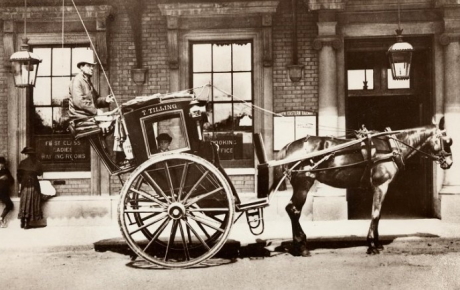
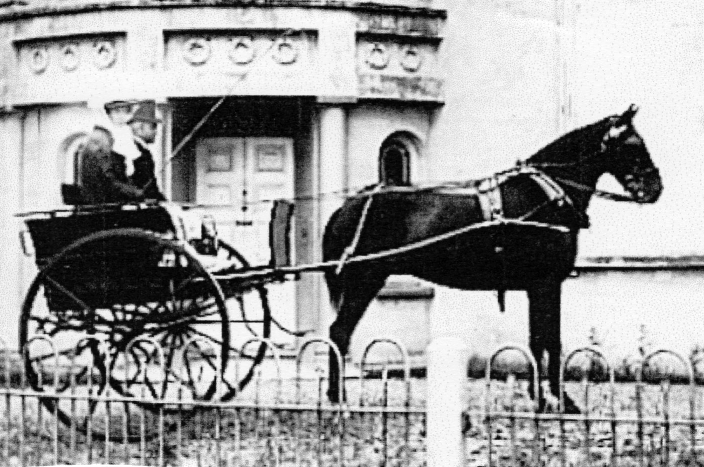
At beginning of the 1800's people travelled on horseback, in horse-drawn vehicles or on foot. Wealthier people travelled in coaches and carriages, others by gig, cart or wagon. Throughout the 19th century, new forms of horse-drawn carriage such as the Barouche, Landau, Brougham and Hansom cab were developed and widely used by the better-off. In Brighton they developed the 'FLY' generally a two horse driven. two people taxi cab which was known for its speed when travelling through the town. Brighton and Hove had lots of Mews around the towns where the horses were stabled and the owners living above (today town houses).
There was an extensive network of scheduled stagecoaches for long-distance travel between major towns, with more than 20 departures a day from Brighton, 10 coaches daily from Worthing (around 15 in the summer season), and 9 or 10 a day from Chichester and Horsham.
By 1839, Sussex had 678 miles (1,091 kms) of turnpiked roads, in addition to 2,368 (3,811 kms) repaired by parish surveyors. Parishes were responsible for maintenance of the highways, but were able to hand control over to Turnpike Trusts. The last such scheme was set up in 1841, the year in which the London-Brighton railway opened. By the later 1840s most coach services in Sussex had stopped running. The turnpiking movement was in decline by the 1850s, burdened by financial debt. However, although the arrival of the railway effectively killed off coaching, the new roads had done much to improve communications for the Victorian period.

From the late 1830s there were some local services of horse-drawn omnibuses, most offering one return trip per day, for example from Shoreham to Brighton, or Bognor to Chichester. Such bus services continued to run throughout Victoria's reign between towns and villages that were not linked by the railway. The need for urban transport grew as towns developed, and by 1901 most towns had a network of horse-drawn bus services running throughout the day to a regular timetable, covering routes within the towns themselves and also providing services to and from the railway stations.
In the 1830s there were some experimental steam-driven coaches and omnibuses but by the mid-19th Century the steam-powered vehicles on the roads were mostly used for agriculture. They were heavy and difficult to control; their speed was also limited by the Locomotive Act 1865 to 4mph (6.44kph) in the country and 2mph (3.22kph) in towns, and they had to be preceded by a man carrying a red flag walking 60 yards (55m) in front, to warn horse riders and horse-drawn vehicles. Petrol-driven cars, developed in the 1880s, were lighter and faster. The Locomotive and Highways Act 1896 raised the speed limit to 14 mph (22.5kph) and abolished the need for light vehicles to be preceded by a person on foot. Although in 1901 the motor car was still a novelty form of transport for the rich, by 1903 when car registration and driver's licences were introduced there were more than 5,000 cars on the road.
Rivers and canals
In the early 19th century, most heavy goods traffic was carried by the canal system which had developed rapidly from the 1770s, expanding to nearly 4,000 miles (6,437 kms) throughout the country by the 1830s.
In West Sussex, the first commercial waterway, the Arun Navigation from Littlehampton to near Billingshurst was opened in 1787, and the Wey and Arun junction Canal, which extended the navigation up to the River Wey south of Guildford, opened in 1816. By 1825, when canal building in West Sussex was over, there were 9 canals and navigations.
It was then possible to transport goods or passengers by boat from the South Coast to London.
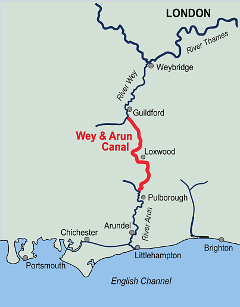
Canal building over by 1825, the canals were still used for commercial activity until the 1870s. The waterways offering commercial navigation then were the rivers Adur, Arun and Rother and the following canals: Baybridge, Chichester Ship, Petworth, Portsmouth and Arundel, Southwick Ship and the Wey and Arun Junction.
The Wey-Arun canal was the only canal linking the South Coast with the Thames, and thus to the national network of canals.
Products such as corn, timber and charcoal, chalk, lime and limestone, marl, iron and marble were easily transported from the landed estates, and livestock was also moved in large numbers.
Most commercial traffic was gradually killed off by competition from the new railways. Although transporting goods by barge was cheaper, canals could not compete with the railway for speed and convenience.
In 1865 the railway line between Guildford and Horsham opened in direct competition with the Wey and Arun canal. By 1868 traffic on the canal had virtually ceased, and in 1871 it was officially closed to commercial traffic. By 1901 commercial traffic had ceased on all but the Adur, Arun, Chichester and Southwick waterways.