Brighton Tram 53 Society - Hastings Tramway
History of Hastings Tramway
Following several abortive attempts to secure powers to build an electric tramway in Hastings and its environs, provisional approval was finally granted in 1899 to the Hastings, Bexhill and District Light Railways (Electric) Company, though it was only for circa 5.25 miles of tramway westwards from the edge of Hastings (in St Leonards), through Bexhill to Cooden. The scheme was backed by the Provincial Tramways Company, which had successfully operated horse tramways since the 1870s, most notably in Portsmouth. The Light Railway Order also incorporated a company — the Bexhill and St Leonards Light Railway Company — to raise the necessary capital to build and operate the tramway. Meanwhile, the PTCo pursued powers to build a further 11.2 miles of tramway within Hastings, these being granted on the 30th July 1900 under the Hastings Tramways Act, 1900. The act effectively combined the old Light Railway Order, which had only been confirmed the month before, and the new lines, authorising the incorporation of yet another new company — the Hastings Tramways Company — to raise the necessary capital and operate both sets of lines, the old company (the B&StLLRCo) being formally dissolved.
Although the HTCo now held powers for circa 16.45 miles of overhead electric tramway, this did not constitute a unitary whole, the system being in two separate sections, namely, the lines within Hastings, and the line out from St Leonards to Cooden. This unsatisfactory state of affairs had been brought about by a well-run campaign against the company's sea front line between Hastings and St Leonards, which local luminaries considered to be an outrageous disfigurement of their beautiful town. Discussions aimed at resolving the impasse did, however, continue, though these took so long that it was necessary to seek an extension of the time allowed to build the LRO lines, this being granted in July 1902 under the Hastings Tramways (Extension of Time) Act, 1902. Agreement was eventually reached to build a connecting line, as well as a line between it and Silverhill to the north, powers for these, totalling 1.83 miles of tramway, being obtained on the 21st July 1903 under the Hastings Tramways (Extension) Act, 1903. However, although the company now held the powers it had long sought, the objectors had successfully introduced a clause into the act forbidding the company from using overhead electric traction along the sea-front, leaving it to come up with a costly and operationally inefficient alternative for this section. At this point the PTCo seems to have lost interest in building and operating the line itself (through its subsidiary, the HTCo), electing in 1904 to sell the HTCo and its powers to a new company, the Hastings and District Electric Tramways Company, which was registered on the 9th November, presumably expressly for this purpose. The HTCo was not, however, dissolved, and remained the legal operating entity throughout the tramway's 24-year existence.
Although construction of the 3ft 6ins-gauge tramway finally commenced on the 7th December 1904, the late start necessitated yet another extension of the time allowed for completing the system, the current powers expiring on the 30th July 1905. An extension to the time allowed for construction was obtained on the 11th July 1905 under the Hastings Tramways Act, 1905, just three weeks before it was due to open. The act also authorised the company to build a further 1.54 miles of line within Bexhill.
The first trial runs of the new electric tramcars took place on the 15th July 1905, and though the system was successfully inspected by the Board of Trade on the 20th July, some key work was still outstanding behind teh scenes, so passenger services did not commence until eleven days later on the 31st July 1905. The first services ran over what was to become known as the circular route (around Hastings), as well as the branch line to Hollington, a second branch from Ore to Hastings Old Town opening the following month on the 21st August 1905. The system was initially operated by 22 tramcars, the fleet being expanded to 30 vehicles later that year.
The line from St Leonards to Bexhill opened on the 9th April 1906, with the extension beyond to Cooden opening three months later on the 28th July 1906, along with the line from Silverhill down to the the coast at Grand Parade. The St Leonards to Cooden section was operated in isolation from the Hastings lines, each having its own depot, at Bulverhythe and Silverhill, respectively. With Hastings Corporation and the sea front businesses vehemently opposed to overhead wires, and the company deeming electrical conduit operation unworkable along a sea front that was frequently subjected to water inundation, the method of traction finally selected was the Dolter surface contact system, studs between the lines being energised by a strong magnet underneath specially equipped tramcars. The connecting line along the sea front finally opened on the 12th January 1907, though there was to be no through running to destinations other than the Albert Memorial as the circular line was simply too steep for the heavy duly quipped cars (Dolter and overhead electric).
The system had now reached its maximum size of 19.57 miles, and was operated by 65 tramcars. From the Albert Memorial in the town centre, a circular route ran clockwise to Silverhill via Bohemia Road, then onto Baldslow via Sedlescombe Road, and along Old London Road through St Helens to Ore; from Ore, the line returned to the town centre via Old London Road, Mount Pleasant Road, St Helens Road and Queens Road. Branches ran northwards from Silverhill to Hollington, along Battle Road, and southwestwards from Ore along Harold Road to the Market Cross in the Old Town. The main line out westwards to Cooden also ran from the memorial, branching off down Robertson Street, via Grand Parade and Marina to St Leonards, continuing westwards along Bexhill Road and De La Warr Road to Bexhill, where it ran along Egerton Road, before heading out to Cooden via Cooden Drive. Lastly, a line along London Road connected Silverhill and the Grand Parade.
The tramway appears to have operated profitably, the only issue being the troublesome and operationally challenging Dolter system, which as the company had feared, did not fare well in a coastal location. This changed in 1913 when the Board of Trade wrote to the company saying that it would no longer licence the line, following issues with the same system at Torquay. Having had one headache solved, the company was, however, immediately faced with another in working out what form of traction should replace it, the corporation presumably still being opposed to the use of overhead traction. The company's answer was to convert the Dolter trams to petrol-electric traction, the electric current for the motors being generated by a noisy and smelly petrol engine, a situation that was hardly designed to endear the sea front trams to travelling public. Conversion of the Dolter cars proceeded apace, the first entering service on the 16th March 1914, the last Dolter car running ten days later on the 26th March 1914.
The system was no doubt heavily impacted by the Great War, suffering from loss of men (and their skills) to the armed services, minimal maintenance, and government restrictions on spares and new materials. Following the cessation of hostilities, the outlook briefly brightened when, in April 1920, the corporation finally relented, agreeing to allow the installation of overhead wires along the sea front. Powers to work the section by overhead electric traction were acquired on the 4th August 1920, under the Hastings Tramways Act, 1920.
The conversion took almost a year, possibly due to post-war procurement issues, but was complete
All was, however, not well, as the early-to-mid 1920s also brought intense motorbus competition, which the company sought to limit by appealing for protection to the council, in return for which it would completely modernise the aging tramcar fleet. The council, however, was having none of it, and even attempted, unsuccessfully, to acquire powers to run motorbuses itself.
Having had its offer to modernise the system rebuffed, the company eventually sought the corporation's support to convert the system to trolleybus operation, a proposal which at last found favour. The company applied for powers to run trolleybuses, both in replacement of tramway routes and on entirely new routes, these being granted on the 29th July 1927 under the Hastings Tramways Company (Trolley Vehicles) Act, 1927.
The first trolleybuses ran on the 1st April 1928 between Hollington and the Fishmarket, with other routes following in quick succession: Silverhill to Memorial via London Road and Grand Parade (21st May 1928); Alexandra Park, Memorial, West Marina and Grand Parade (30th July 1928); West Marina to Cooden (18th September 1928); Leaton Road to St Helens via Priory Road and Ore (24th January 1929); and Clive Vale and Old London Road shortly afterwards.
The last trams, operating between Silverhill and St Helens were withdrawan on the 15th May 1929, bringing almost twenty-four years of tramway operation to a close.
Litlle has been published on the financial affairs of the HTCo, but what little there is shows it to have paid very respectable dividends, and this, coupled with the post-war proposals to modernise the system, strongly suggest that it must have been a very profitable enterprise.
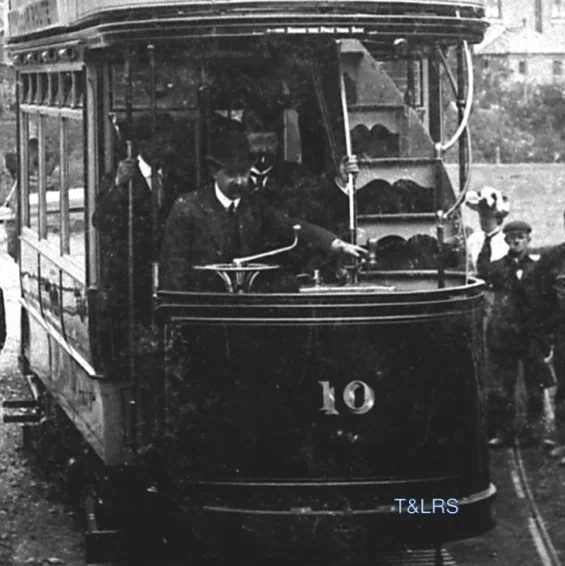
Uniforms Several photographs taken around the time of opening (1905) show tramcar staff in informal yet smart attire; although some of these shots are clearly of trial runs (of which there were many), others are of bone fide services, local newspapers commenting on the untidyness of some staff, presumably those without uniforms.
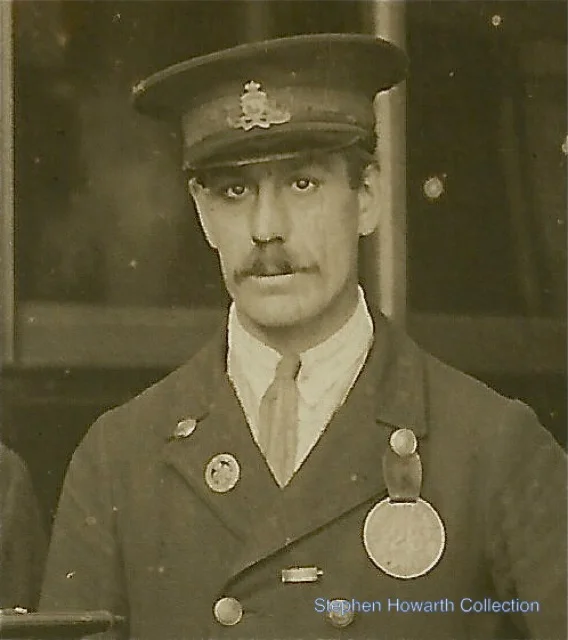
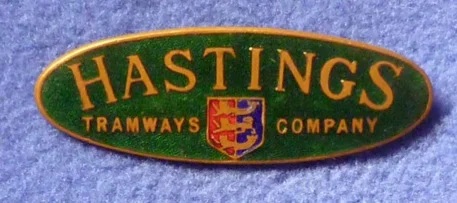
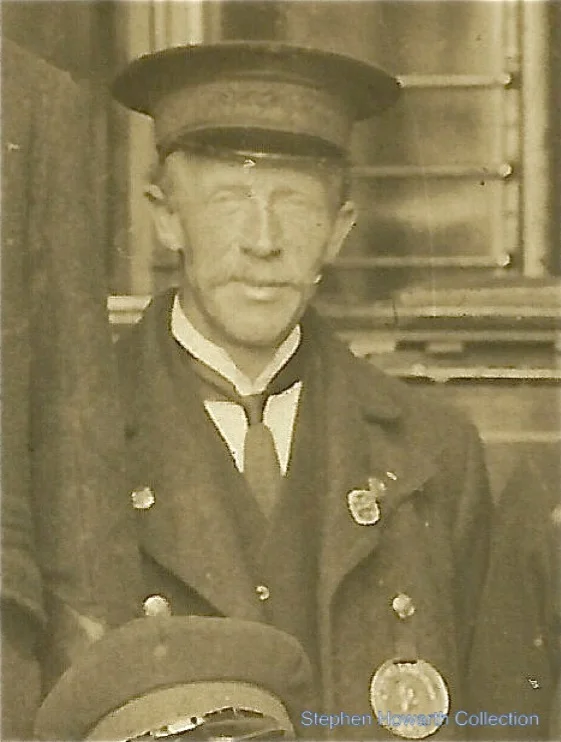
Motormen and conductors were eventually issued with sturdy double-breasted jackets with four pairs of brass buttons (bearing the company title and monogram — see link), with the top pair buttoning between the lapels and the collars. The collars initially bore some kind of insignia, possibly embroidered company initials — 'H T C'. The tensioned-crown peaked caps bore a hat band, more than likely in a contrasting colour to the cap, which carried embroidered lettering, either 'HTC Motorman' or 'HTC Conductor', with the 'HTC' in block capitals and the grade in script lettering (see below). Apart from the collar insignia, which seems to have been dispensed with quite early on, the basic style of the uniform remained unchanged for the entire lifetime of the tramway.
Motormen and conductors were also provided with double-breasted greatcoats with five pairs of buttons, and lapels; other than the company buttons, these garments bore no badges.
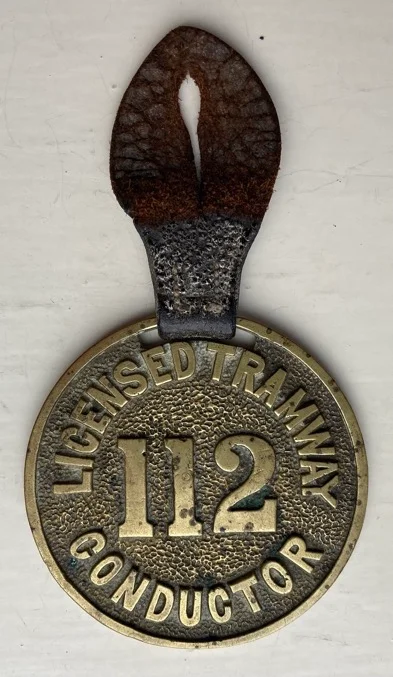
Hastings Corporation required all tramcar staff to be licensed, as a result of which, a large round brass licence badge was worn; this was suspended on a leather hanger, usually from the bearer's top left jacket button. The licence badge bore a number in the middle with 'LICENSED TRAMWAY' above and the grade at the bottom, both in curved block capitals. An example of a 'CONDUCTOR' licence badge has survived (see below), and examination of photographs would suggest that the motorman equivalent bore 'DRIVER'.
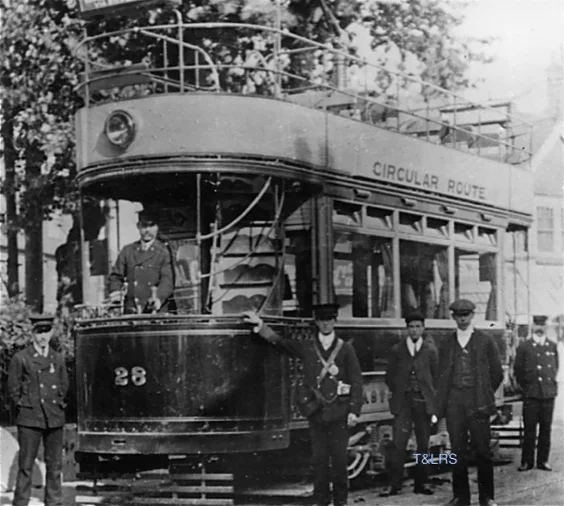
Inspectors and timekeepers seem to have worn similar, if not identical jackets and greatcoats to those worn by motormen and conductors. Caps were also of the tensioned-crown type, but appear to have carried a large oval, embroidered cloth cap badge, possibly bearing system initials — 'H T C' — and the bearer's grade. Hastings also employed the services of a traffic superintendent; if the identification is correct (which is by no means certain), then he wore the same uniform as everyone else, but with an elaborately braided hat band.
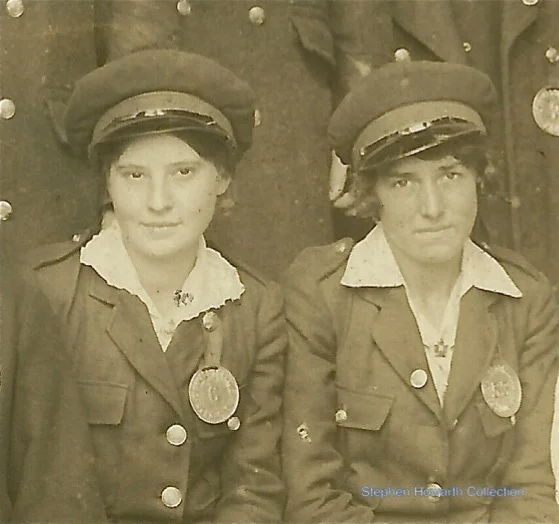
In common with the vast majority of UK tramways, the Hastings Tramways Company employed women during the Great War to replace male staff lost to the armed services; these ladies were certainly employed as conductresses (the company had around fifty by the 21st March 1916), and at least one as a ticket inspectress, though it is less clear if they ever took on driving duties. They were issued with single-breasted jackets with five buttons, two breast pockets (with button closures) and plain lapels, along with a long matching skirt. The glossy peaked caps had baggy crowns, a style which is sometimes referred to as motor caps; they do not appear to have carried a badge.
On 1st September 1914, the company had in their employ, 68 motormen, 68 conductors (4 learners), 8 inspectors, 1 timekeeper and 1 traffic superintendent (Hastings Tramways Centenary 1905-2005 by D Padgham; Hastings Local History Group 2005.
Hastings Tramways Mini Museum
Cripps Corner Road, Robertsbridge TN32 5QR
Every, Wednesday, Saturday and Sunday
Free Parking onsite
Bus service 349 (Stagecoach) operates to us from Hastings, Sedlescombe and Bodiam. (Just requested the Trams with the Carraige cafe to your driver) Free Entry for the family with lots to see and do.