Brighton Tram 53 Society - WW1
At the time of WW1 breaking out in 1914, Brighton Corporation Tramways had 273 employees. The War Mobilisation Order meant 114 were conscripted. As a result, all remaining employees worked 7 days a week for 11 hours a day.
During 1914 injured Indian soldiers were reurning from the war in France and were sent to Brighton's newly established state of the art medical hospitals for damaged or missing limbs treatment (1914-1916), then in (1916-1920) British & Candian soldiers).
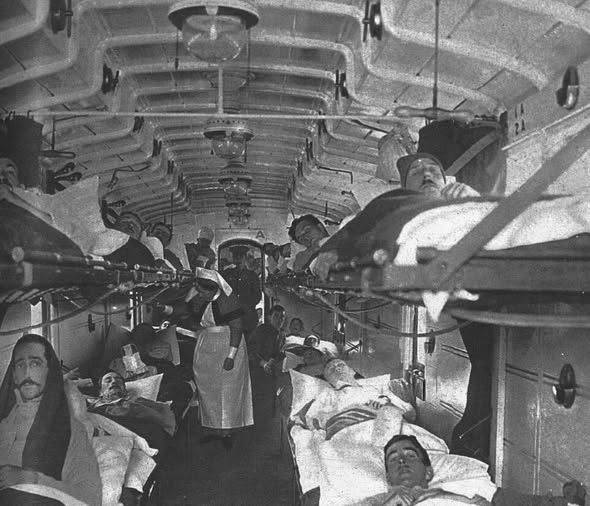
They were sent by train from Dover/Southampton, and on arriving at Brighton, the military ambulances found they could not cope, between 1915-1919 an estimated 30,070 needed treatment. The decision was made to use Brighton's Trams to assist in the transportation of patients to the Royal Pavilion Hospital Estate (included the Corn Exchange & Dome), the Lord Kitchener Hospital (the Workhouse – later Brighton General Hospital - Elm Grove) and Brighton Grammar School (Dyke Road).
Brighton, Hove and Sussex Grammar School
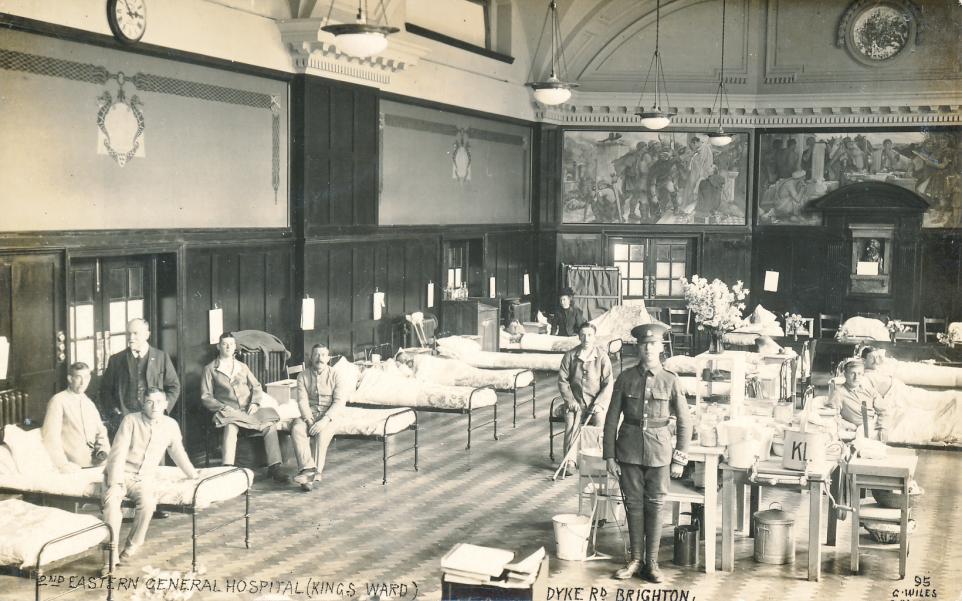
in Dyke Road, known today as BHASVIC, transformed into a hospital during the 1914 to 1918 conflict, providing a total capacity of 1,288 beds, 98 beds for officers and 1,190 beds for other ranks.Requisitioned when not much more than a year old and designated the Second Eastern General Hospital, it accommodated large numbers of men who arrived at Brighton Station direct from the battlefields, mainly via Dover, and was the administrative headquarters of several other hospitals in the town, such as Lewes Crescent Hospital in Kemp Town and Stanford Road Hospital - another converted school.
Brighton Corporation Trams was part of the transportation
of injured soldiers to this hospital.